
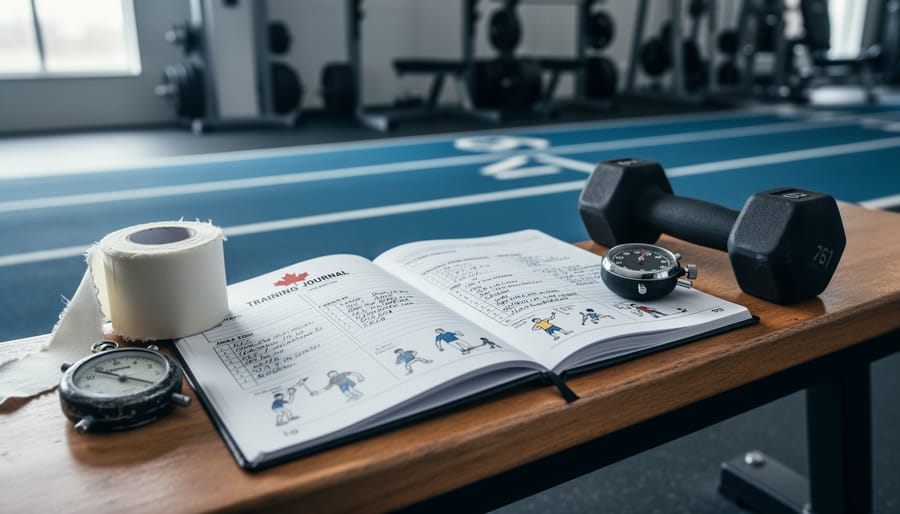
How Athletic Training Journals Transform Local Athletes Into Regional Champions
A journal athletic training system transforms raw talent into measurable performance gains by tracking workouts, recovery periods, and competition results in a structured format that reveals patterns invisible to the naked eye. For athletes across southwestern Ontario competing in everything from high school track meets to regional hockey tournaments, the difference between plateau and breakthrough often comes down to whether they’re documenting their training intelligently or simply going through the motions.
Behind the scenes at training facilities from Windsor to Owen Sound, coaches who’ve guided athletes to provincial championships credit systematic journaling as the hidden engine of success. The practice goes beyond scribbling notes after practice. It creates a feedback loop where athletes record metrics like sprint times, weight lifted, sleep quality, and even mental state, then analyze trends that inform smarter programming decisions.
What separates effective training journals from abandoned notebooks is specificity. Recording “legs felt tired” offers little value compared to documenting that quad strength dropped 12% three days after a tournament, revealing a clear recovery deficit. Local strength coaches working with CIS-bound athletes in 2026 emphasize that journals should capture both quantitative data (reps, sets, times) and qualitative observations (energy levels, technique struggles) to build a complete performance picture.
The real power emerges over weeks and months. Patterns surface: performance spikes correlate with certain nutrition timing, injuries follow specific training loads, mental focus improves with adjusted rest days. This data-driven approach removes guesswork, letting athletes and coaches make adjustments grounded in personal evidence rather than generic advice.
What Athletic Training Journals Really Track (And Why It Matters)
When you flip through an athletic training journal from a Windsor hockey player or a London track athlete, you’re not just looking at numbers on a page. These records capture the complete picture of athletic development, documenting everything that separates consistent performers from those who plateau or peak at the wrong time.
At the core, training journals track the fundamentals that every competitive athlete needs to monitor. The most comprehensive journals document:
- Daily workout details including exercises, sets, reps, weights, and rest intervals
- Performance metrics specific to the sport (sprint times, jump heights, throw distances)
- Recovery indicators such as sleep quality, resting heart rate, and soreness levels
- Nutrition intake with calorie counts, macronutrient breakdowns, and hydration levels
- Mental state notes covering motivation, focus, anxiety, and competition readiness
- Injury reports and rehabilitation progress
- Environmental factors like training location, weather conditions, and equipment used
The real value emerges when athletes track these elements consistently over weeks and months. A Waterloo cross-country runner might notice her best performances consistently follow specific carbohydrate loading patterns. A Sarnia football player could identify that his strength gains stall when he drops below seven hours of sleep for three consecutive nights.
This pattern recognition transforms raw data into actionable intelligence. Local coaches working with athletes at regional championships report that journaling athletes adjust their training 30 to 40 percent faster than those relying on memory alone. They spot overtraining before it leads to injury, recognize when recovery protocols aren’t working, and fine-tune nutrition timing to match their competition schedule.
The mental preparation component deserves special attention. Athletes competing at Western University or representing southwestern Ontario at provincial events consistently report that documenting pre-competition routines and emotional states helps them replicate successful mindsets. One Kitchener volleyball player discovered through her journal that visualization exercises two days before matches correlated with her best serving performances, a connection she never would have identified otherwise.
For regional athletes balancing training with school or work, journals also reveal time management patterns. Tracking when sessions happen, not just what happens during them, shows which scheduling approaches yield the best results given real-world constraints.
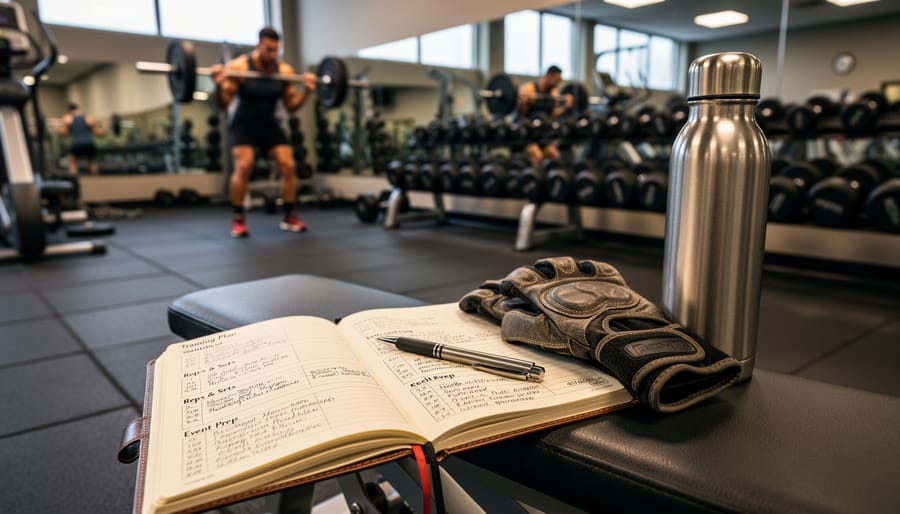
Behind the Scenes: How Southwestern Ontario Athletes Use Training Journals

From High School Stars to University Prospects
When Logan Pierce moved from Forest Heights Collegiate to the University of Windsor’s track program last fall, her training journal became her most powerful recruiting tool. The 400-meter specialist had meticulously documented three years of split times, strength progression, and race strategies, data that caught the attention of coaches during recruitment visits.
“They weren’t just looking at my best times,” Pierce explains. “They wanted to see consistency, how I responded to setbacks, and whether I actually understood my own development.” Her journal revealed a pattern of steady improvement and self-awareness that spoke louder than any highlight reel.
Coaches across southwestern Ontario increasingly emphasize journaling for their high school athletes with university aspirations. St. Thomas Aquinas coach David Marchetti requires his senior athletes to maintain detailed logs specifically because recruitment conversations demand more than raw talent. Scouts want evidence of coachability, dedication, and analytical thinking, qualities that emerge clearly in well-maintained training records.
The documentation proves particularly valuable during the dreaded injury periods that derail many promising careers. When Cambridge’s Jake Thornton tore his ACL midseason, his training journal became a roadmap for his comeback. University recruiters stayed engaged because they could see his methodical approach to rehabilitation and his commitment to process over panic. He signed with McMaster six months later, journal entries and all.
The Weekend Warrior Advantage
For the thousands of southwestern Ontario athletes who compete in weekend tournaments, charity runs, and recreational leagues while holding down full-time jobs, training journals solve a critical problem: how to make every workout count when you’ve only got a few hours per week.
Mike Henderson, a Kitchener accountant who races in regional triathlons, keeps his journal on his phone. “I track my Tuesday morning swims, Thursday evening bike rides, and weekend long runs. When I can only train five hours weekly, I need to know if those five hours are actually moving me forward or just maintaining fitness.” His journal revealed he was overemphasizing endurance at the expense of speed work, an insight that helped him shave twelve minutes off his half-marathon time.
The weekend warrior’s journal looks different from an elite athlete’s. Instead of multiple daily entries, it captures quality over quantity. Most track three core elements: workout intensity relative to available energy (because training tired produces junk miles), recovery indicators like sleep quality and work stress, and whether sessions aligned with upcoming event demands.
Local hockey league players have adopted a simplified version, logging ice time quality, post-game soreness, and whether they had enough gas in the third period. This data helps them adjust pre-game nutrition and determine if their twice-weekly gym sessions are actually enhancing their weekend performance.
The pattern recognition matters most. A Guelph runner discovered through six months of entries that her best race performances always followed weeks where she reduced volume but increased intensity, a finding that contradicted the “more is better” mentality she’d absorbed from training articles written for full-time athletes.
Digital vs. Traditional: What Works Best for Local Athletes in 2026
The debate between pen and paper versus smartphone apps has shifted dramatically in southwestern Ontario’s athletic community over the past two years. Coaches at local training facilities report that roughly 60% of their athletes now use digital platforms exclusively, while 25% stick with traditional notebooks and 15% blend both methods depending on the training phase.
Traditional paper journals offer tangible benefits that resonate with many local athletes. The physical act of writing after a hard workout creates a ritual that helps process the session mentally. Waterloo runner Marcus Chen keeps his leather-bound journal in his gym bag specifically because flipping back through months of handwritten entries gives him a visceral connection to his progress that scrolling doesn’t replicate. There’s no battery anxiety, no software updates, and no learning curve for athletes who prefer simplicity.
Digital platforms, however, deliver analytical power that paper can’t match. Apps like TrainingPeaks and Whoop automatically calculate training load, flag recovery deficits, and identify patterns across weeks of data in seconds. London triathlete Sarah Patel switched to digital tracking when preparing for provincial competitions because her coach could access her metrics remotely and adjust her program between weekly meetings. The immediate feedback loop accelerated her development noticeably.
- Digital platforms provide instant data visualization and trend analysis that reveal patterns invisible in handwritten logs.
- Cloud syncing lets coaches and trainers monitor athlete progress remotely and intervene before small issues become injuries.
- Paper journals never crash, lose data, or require charging, making them completely reliable in any training environment.
- The physical writing process enhances memory retention and creates a stronger mental connection to training details.
- Digital systems can be expensive with monthly subscription fees ranging from $10 to $30 for comprehensive features.
- Athletes report spending too much time inputting data or obsessing over metrics instead of focusing on actual training quality.
- Paper journals lack analytical capabilities and make it difficult to spot subtle trends across multiple training variables.
- Handwritten logs are easily lost or damaged and can’t be shared instantly with coaching staff or medical professionals.
Sport type influences the choice considerably. Team sport athletes in hockey and basketball often prefer paper for quick post-practice notes, while endurance athletes gravitate toward digital for the precise tracking their training demands. Combat sport athletes at Kitchener’s gyms frequently use hybrid approaches, logging technique work by hand but tracking strength and conditioning digitally.
The cost factor matters for younger athletes. While elite apps charge premium prices, free options like Google Sheets or basic note apps provide middle ground for high school athletes building their first systematic training records. The best system is whichever one an athlete will actually use consistently, regardless of format.

The Connection Between Training Journals and Event Performance
The difference between showing up race-ready and bonking halfway through comes down to recognizing patterns months before the starting gun fires. Athletes who maintain detailed training journals gain a tactical edge through accumulated data points that reveal exactly when their body peaks, where weaknesses emerge, and how long recovery actually takes, not how long they think it should take.
Consider preparation cycles for southwestern Ontario’s summer racing season. Athletes who journal through the winter months can chart their progression through base-building, intensity phases, and taper periods with precision. A runner preparing for the London Marathon in May doesn’t guess at peak week; they reference previous cycles that showed optimal performance arriving 10-12 days after their final hard workout, not the conventional three weeks most training plans prescribe. This individualization separates podium finishers from middle-of-pack hopefuls.
The injury prevention angle carries even more weight. By tracking sleep quality, muscle soreness ratings, and session RPE (rate of perceived exertion) alongside workout loads, athletes spot overtraining signals before they cascade into stress fractures or tendon strains. Systematic monitoring fatigue and recovery through journaling reveals patterns invisible during individual training days, like performance drops that consistently follow two consecutive high-volume weeks or persistent elevated heart rates indicating inadequate recovery.
Local coaches point to pre-competition journaling as the ultimate dress rehearsal tool. Athletes document everything during smaller regional events: warm-up timing, pre-race meals, gear choices, mental state. When provincial championships arrive, they’re executing a proven playbook rather than experimenting under pressure. One Waterloo triathlete credits her journal’s race-day protocols for cutting 12 minutes off her time after realizing through pattern analysis that she consistently underperformed when nervous, prompting her to adjust her mental preparation routine weeks before major competitions.
Starting Your Own Athletic Training Journal: Practical Steps
Starting your own athletic training journal doesn’t require expensive equipment or complex systems. A notebook and pen work just as well as a dedicated app, as long as you commit to consistent documentation. The key is choosing a method you’ll actually use after a tough training session or competition.
Begin with these essential steps:
- Select your tracking method based on your comfort level with technology and when you typically reflect on training. Digital apps offer instant graphing and pattern recognition, while physical journals provide fewer distractions and work anywhere without battery concerns.
- Establish your core tracking categories before your first entry. At minimum, record date, activity type, duration, intensity level, and how you felt during and after. Add specific metrics relevant to your sport once you’ve built the basic habit.
- Set a consistent journaling time that fits your routine. Most southwestern Ontario athletes journal immediately post-workout while details remain fresh, though some prefer evening reflection sessions that capture recovery status.
- Create a simple rating system for subjective measures like energy, motivation, and soreness. A 1-10 scale works for most athletes and enables pattern recognition over weeks and months.
- Review your entries weekly to spot trends. Look for connections between sleep quality and performance, nutrition timing and energy levels, or training volume and injury risk signals.
Start minimal rather than tracking everything at once. Athletes who begin with five core data points maintain their journals far longer than those who create elaborate systems they abandon within weeks. You can always add categories as the habit solidifies.
The first month feels tedious for most athletes. Push through this phase, because the real value emerges when you accumulate enough data to recognize patterns. That’s when you’ll notice that your best performances consistently follow specific preparation routines, or that certain training combinations leave you overtrained.
Reserve ten minutes after each training session for documentation. This small time investment compounds into a comprehensive record that reveals what actually works for your body, not just what theoretically should work.
The transformation of southwestern Ontario’s athletic landscape through systematic training documentation isn’t just a trend, it’s become fundamental infrastructure for competitive success. From Windsor to London, Waterloo to Sarnia, athletes who commit to detailed journaling consistently outperform peers with similar natural talent but less structured preparation. This isn’t speculation; it’s what we’ve observed covering regional competitions throughout 2026.
Training journals have bridged the gap between recreational passion and serious competitive pursuit. They’ve given weekend warriors the tools to train like professionals, helped high school standouts make data-driven improvements that catch university scouts’ attention, and provided coaches with objective baselines for tailoring programs to individual athletes. More importantly, they’ve democratized elite-level preparation methods, making them accessible to athletes without access to expensive sports science facilities.
Looking ahead, expect training documentation to become even more integrated into southwestern Ontario’s sports culture. As regional competitions grow more sophisticated and local athletes continue punching above their weight class at provincial and national events, systematic journaling will separate the prepared from the hopeful. The athletes breaking through aren’t necessarily the most naturally gifted, they’re the ones who understand their bodies, recognize their patterns, and adjust based on evidence rather than guesswork.
The question for local competitors isn’t whether to keep a training journal anymore. It’s how quickly they’ll start.