

7 MMA Betting Lines Every Fighter Fan Should Know Before Placing a Wager
MMA betting lines break down into seven core formats that dictate how you wager on fights and what you stand to win. Understanding moneyline odds, point spreads, over/unders, prop bets, parlays, live betting lines, and futures markets gives you the complete toolkit for profitable MMA wagering. Each line type serves a different strategic purpose, from straightforward winner-picks to complex multi-fight combinations that can deliver better odds when you know where to look.
The challenge most bettors face isn’t finding lines but reading them correctly. A -240 favorite means something entirely different than a +180 underdog, and misreading the math costs money fast. Oddsmakers set these lines by weighing fighter records, stylistic matchups, injury reports, and public betting patterns, but sharp bettors exploit the gaps between perception and reality.
For southwestern Ontario fight fans watching local talent climb through the ranks or betting on marquee UFC cards, mastering line interpretation separates casual gamblers from consistent winners. The difference between placing bets and placing smart bets comes down to fluency in how these seven line types work, when to use each one, and where value hides in plain sight.
Why Understanding Betting Lines Matters for MMA Wagering
MMA betting lines work differently than team sports because you’re evaluating individual combat athletes, not collective performance across multiple players. When oddsmakers price a UFC fight, they’re weighing fighting styles, recent form, training camp quality, weight cut concerns, and psychological factors that rarely matter in football or basketball. There’s no teammate to carry a struggling fighter, and a single punch can end everything in seconds.
This unpredictability is exactly why understanding betting lines matters so much. The seven line types covered in this article were selected because they represent the essential markets where bettors can actually find value if they know what to look for. Moneyline, round totals, method of victory, round betting, parlays, live betting, and specialized props each reveal different aspects of how the market views a matchup.
Sharp bettors don’t just pick winners, they study how lines move from the moment they’re posted until the cage door closes. A moneyline that opens at -180 and shifts to -220 tells you where the smart money is going, and more importantly, whether you’re getting good or poor value at the current number. Behind the scenes, oddsmakers start with statistical models and fighter metrics, then adjust based on public betting patterns and insider information from coaches, managers, and media members embedded in fight camps.
That’s why reading line movement isn’t optional. If you’re betting the current number without knowing where it started or why it moved, you’re gambling blind. The betting market for MMA constantly adjusts to new information, and the bettors who profit are the ones interpreting those adjustments correctly.
1. Moneyline Odds: The Foundation of MMA Betting
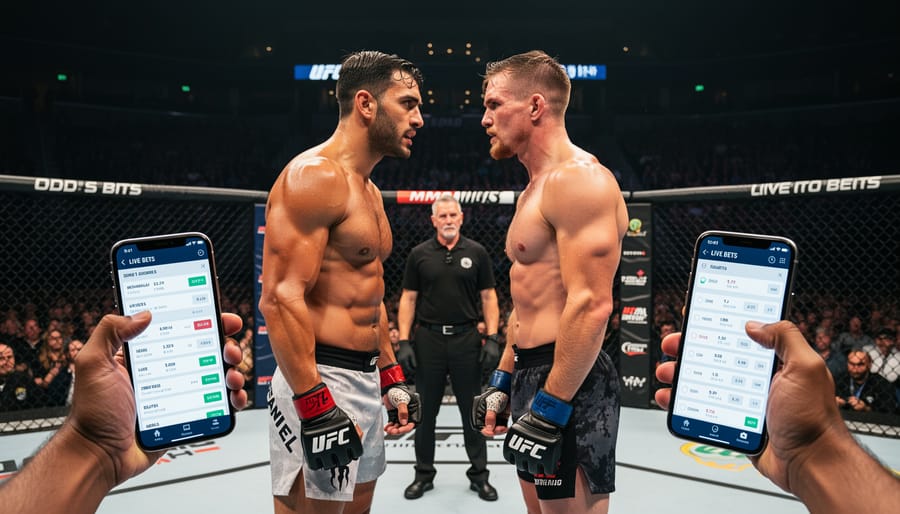
Moneyline betting strips MMA wagering down to its essence: pick who wins the fight. No point spreads, no round predictions, just fighter A or fighter B. This simplicity makes moneylines the entry point for most bettors, but reading the numbers correctly separates casual guesses from informed wagers.
The odds appear as positive or negative numbers beside each fighter’s name. A negative number like -180 indicates the favorite, how much you’d need to risk to win $100. At -180, you’d bet $180 to profit $100 if that fighter wins. Positive numbers mark the underdog and show profit on a $100 bet. At +150, a $100 wager returns $150 profit if the underdog pulls the upset.
These aren’t static figures. Lines shift as money flows in and new information surfaces. A fighter opening at -140 might move to -170 by fight week if sharp bettors hammer that side or if their opponent shows up looking drained at weigh-ins. Sometimes the public overreacts to a popular name, inflating the favorite’s line and creating value on the underdog. A skilled wrestler facing a flashy striker might be undervalued at +130 simply because casual fans gravitate toward highlight-reel knockouts.
The real edge comes from catching favorable numbers early or recognizing when the market has mispriced a matchup. Track how lines move from opening to close. When bookmakers adjust, they’re responding to betting pressure or insider knowledge filtering through the market, information worth noting before you commit your stake.
2. Over/Under Round Totals: Betting on Fight Duration
Over/under round totals let you wager on whether a fight will last longer or shorter than a bookmaker’s predicted duration. Instead of picking a winner, you’re betting on how many rounds the bout will complete. A line might be set at 2.5 rounds for a championship fight, bet the over if you think it goes past the halfway point of round three, or the under if you expect a finish before then.
The oddsmakers base these lines on several concrete factors. Fighter styles matter tremendously: aggressive brawlers with knockout power push the line lower, while defensive technicians or grapplers who prefer grinding out decisions raise it. A matchup between two heavy-handed strikers might have an under-leaning line of 1.5 rounds, whereas a grappling-heavy clash between submission specialists could sit at 3.5 or 4.5 rounds.
Cardio and fight history provide crucial clues. Check how often each fighter has seen the final bell versus scoring early finishes. A competitor with eight first-round stoppages in ten fights screams “under” consideration, particularly if facing an opponent with known defensive vulnerabilities. Conversely, two fighters averaging 22 minutes of cage time per bout suggest the over holds value.
The most common mistake? Overvaluing knockout highlights. One viral head-kick finish doesn’t erase a fighter’s cardio issues or their opponent’s granite chin. Sharp bettors dig into full fight statistics, significant strikes absorbed per round, takedown defense percentages, and submission escape rates, rather than betting based on Instagram clips. Context beats hype when projecting fight duration.
3. Method of Victory Props: Predicting How the Fight Ends
Method-of-victory props let you wager not just on who wins but how they’ll finish the fight, knockout, technical knockout, submission, or decision. These bets carry higher payouts than straight moneylines because you’re adding specificity, and bookmakers price that added difficulty accordingly. A fighter favored at -200 on the moneyline might offer +150 to win by KO/TKO or +300 by submission, rewarding bettors who accurately read the matchup dynamics.
The research required goes beyond win-loss records. You need to study finishing rates: does this fighter end 70% of wins by knockout, or do they grind out decisions? Look at opponent vulnerabilities, a striker with poor takedown defense facing an elite grappler makes submission props attractive. Training camp reports, recent performance trends, and stylistic mismatches all feed into sharp method-of-victory plays.
Real-world payoffs happen when tendencies align with opportunity. Consider a submission specialist moving up in weight to face a wrestler with a history of getting caught in guillotines. That submission prop at +400 becomes compelling. Or a heavy-handed brawler matched against a chinny opponent who’s been stopped in three of his last five fights, the KO/TKO line offers value if you’ve done the homework.
The mistake casual bettors make? Chasing big odds without digging into why a fighter finishes fights the way they do. A five-round championship bout between two defensive grinders rarely ends early, no matter how tempting those knockout odds look. Understanding responsible betting means matching the prop to the matchup realities, not just the payout size.
4. Round Betting: Pinpointing the Exact Finish
Round betting takes MMA wagering to a granular level, you’re not just picking who wins, but the precise round in which they finish their opponent. This means successfully calling both the victor and the exact timing of the stoppage, whether by knockout, submission, or technical decision.
The payouts reflect the difficulty. While a standard moneyline favorite might pay -200, predicting that same fighter wins in Round 2 could return +800 or higher. You’re essentially stacking two predictions: the outcome and the specific three-to-five-minute window it happens. Miss either element, and the bet loses.
Oddsmakers price these lines by analyzing historical finish rates for both fighters. A knockout artist with a pattern of early stoppages will have shorter odds on Rounds 1-2, while a submission specialist known for late finishes might show value in Rounds 3-5. They also factor in stylistic matchups, an aggressive striker facing a slower defender creates different round-betting probabilities than two defensive grapplers.
Smart bettors target round props when they’ve identified a clear stylistic mismatch. If you’ve studied fight tape and noticed one fighter consistently struggles with early pressure, betting their opponent to finish in Round 1 offers better value than a straight moneyline. These wagers work best when you have conviction about how a fight unfolds, not just who prevails.
The key is pattern recognition. Fighters who’ve finished their last three opponents in the opening round deserve round-betting consideration, especially if facing similar opposition.
5. Parlay Lines: Combining Multiple Bets for Bigger Payouts
Parlay betting takes the adrenaline of a single MMA wager and multiplies it, you’re linking multiple fight outcomes on one ticket, with the potential for exponentially bigger payouts. Instead of betting individual moneylines, you might combine three favorites across a fight card: say, a -200 favorite, a -150 favorite, and a -300 favorite. If all three win, your payout multiplies those odds together rather than treating them separately. A $100 parlay on those three fighters would return roughly $260 instead of requiring three separate tickets with much smaller individual returns. The allure is obvious, one winning ticket, one bigger score.
But here’s the catch: it’s all or nothing. If two of your three picks win and one loses, the entire parlay busts. You don’t get partial credit, and you don’t get your stake back. That single wrong call erases everything, which is why parlays carry significantly more risk than straight bets. Bookmakers love parlays because the house edge compounds with each added leg, the more fighters you stack, the harder it becomes to hit every outcome.
Strategic bettors approach parlays carefully. Mixing heavy favorites with a single underdog or prop can balance risk and reward, locking in likely outcomes while giving yourself one higher-payout swing. Some experienced bettors parlay a favorite’s moneyline with an over/under or method-of-victory prop from the same fight, capitalizing on correlated outcomes. For example, if you believe a wrestler will dominate and control the pace, you might parlay their moneyline with the fight going over 2.5 rounds.
Bankroll discipline matters more with parlays than any other bet type. A common rule: never risk more than 1-2% of your total bankroll on a parlay, regardless of how confident you feel. The math works against you over time, so treat parlays as occasional lottery tickets rather than your core betting strategy.
6. Live Betting Lines: Wagering During the Fight
Live betting transforms MMA wagering into a dynamic, real-time chess match where odds adjust with every strike, takedown, and momentum shift. Unlike pre-fight lines that lock in when the cage door closes, live betting lets you capitalize on what you’re watching unfold, but you’ll need sharp instincts and even sharper timing.
The most dramatic line movements happen when visible injuries change the fight’s trajectory. A badly swollen eye, compromised leg from checked kicks, or labored breathing between rounds can swing odds 30-40% in seconds. Sportsbooks adjust aggressively because these physical tells telegraph potential finishes. If you notice a fighter’s output dropping or defensive lapses appearing before the oddsmakers react, that’s your window for value.
Round-by-round scoring also creates exploitable moments. When judges score a round differently than the broadcast commentary suggests, public money often pushes lines in the wrong direction. Sharp bettors who understand MMA judging criteria, control, effective striking, aggression, can fade the crowd and back the fighter whose technical work is accumulating points even if it lacks highlight-reel flash.
Training camp reports become critical context here. If you knew a fighter worked specifically on cardio for championship rounds, that third-round fatigue from their opponent presents a live betting opportunity others might miss.
The cardinal rule: decide fast but don’t chase bad lines. Hesitate for 15 seconds and the odds you wanted vanish. Panic-bet without conviction and you’re gambling on recency bias instead of legitimate value. Watch the fight through a bettor’s lens, track output, damage accumulation, cage control, and strike when you spot something the market hasn’t fully priced yet.
7. Fighter vs. Fighter Head-to-Head Props: Specialized Matchup Bets
Fighter vs. fighter head-to-head props let you bet on specific in-fight performance metrics rather than just who wins. These specialized lines pit one fighter’s statistical output directly against their opponent’s: Will fighter A land more significant strikes than fighter B? Who records the first takedown? Which corner accumulates more control time?
Sportsbooks release these props for marquee matchups where they have deep fighter data to draw from. You might find lines on total strikes landed, leg kicks thrown, submission attempts, or even cage control minutes. The key is that you’re betting on a measurable event that happens during the fight, not the final result.
Sharp bettors who study fight film and comb through UFC Stats databases often find edges here that don’t exist in standard moneyline markets. If you’ve identified that one fighter consistently averages eight takedown attempts per fight while his opponent has stuffed 85% of takedowns over his last five bouts, you can build a case for the “under” on successful takedowns.
These props frequently offer better value than picking a straight winner, especially in closely matched fights where the moneyline sits near even. When two elite strikers meet and the moneyline is tight, a prop on total significant strikes might present clearer edges based on output tendencies and pace. The downside is liquidity, prop markets have lower limits and less line shopping opportunities than main event moneylines. Still, if your research points to a statistical mismatch the oddsmakers haven’t fully priced in, head-to-head props reward that homework.
Reading Line Movement and Finding Value
Line movement in MMA reveals the real story behind the betting action. When a line opens at -180 for a favorite and shifts to -220 by fight night, that change tells you where the smart money is flowing. Sharp bettors often strike early, while casual fans pile on closer to the event, creating distinct patterns you can exploit when using lines to your advantage.
Track these key signals to spot value before it disappears:
- Sudden line shifts within hours, typically indicates insider information or large sharp money
- Gradual movement toward an underdog, suggests respected bettors see value the public missed
- Lines that hold steady despite lopsided ticket counts, bookmakers believe the opening number is correct
- Reverse line movement where favorites get shorter odds on less betting volume, clear sharp money indicator
News drives dramatic swings. A training camp injury report can flip a -150 favorite to a +120 underdog overnight. Weight-cut struggles at ceremonial weigh-ins often trigger immediate line adjustments as bettors anticipate diminished performance. Monitor fighter social media, credible MMA journalists, and official UFC announcements in the 48 hours before fight time.
Contrarian betting works in MMA because public perception lags behind reality. When a beloved striker faces an unglamorous grappler, casual money floods toward the popular fighter regardless of stylistic matchup. This creates inflated lines on favorites and genuine value on underdogs with tactical advantages. The best opportunities emerge when public narrative contradicts technical analysis, a fighter coming off a highlight-reel knockout draws bets even when facing a stylistic nightmare.
Common Questions About MMA Betting Lines
Where can southwestern Ontario bettors find the best MMA betting lines?
Legal online sportsbooks operating in Ontario, like Bet365, FanDuel, and theScore Bet, offer competitive MMA lines with the convenience of line shopping from your phone. Comparing odds across multiple platforms before placing a wager often reveals meaningful differences in payout potential.
How much does line shopping actually matter for MMA betting?
Even small differences in odds compound over time. A fighter priced at -150 on one book versus -130 on another means you’re risking less for the same payout, and these gaps add up significantly across dozens of wagers throughout a season.
Is MMA harder to bet than team sports like hockey or basketball?
MMA presents unique challenges since one punch can change everything, but it’s also simpler in some ways, you’re analyzing two fighters instead of entire rosters and complex team dynamics. The key is understanding individual fighting styles and how they match up rather than juggling dozens of variables.
What’s the best way to start betting MMA with small stakes?
Begin with straight moneyline bets on well-researched fights rather than complex parlays or exotic props. Wagering $10 to $20 per fight lets you learn how lines move, which factors matter most, and how your analysis translates to results without risking serious money while you’re building expertise.
The biggest mistake new MMA bettors make is treating every fight card the same. Main events between ranked contenders typically offer sharper, more efficient lines because they attract heavy action from experienced bettors. Preliminary card fights, especially those featuring debuting fighters or last-minute replacements, often present better value opportunities since oddsmakers have less information and the betting public pays less attention. Start by focusing on fighters you’ve actually watched compete multiple times rather than chasing big underdogs based solely on odds, familiarity with fighting styles beats hunches every time.
Mastering these seven betting line types transforms how you approach MMA wagering. You’re not just throwing money at a favorite or chasing long-shot payouts, you’re making calculated decisions backed by genuine understanding of how odds work, what drives line movement, and where bookmakers might have mispriced a matchup.
Start small. Focus on moneylines and round totals until you can consistently read the numbers without hesitation. Then layer in method-of-victory props and live betting as your fight analysis sharpens. The fighters who dominate the octagon didn’t learn every technique overnight, and neither will you master betting lines in a single event.
Track your wagers. Review what worked and what didn’t. The education never stops, new fighters emerge, styles evolve, and betting markets adjust. Responsible bankroll management matters more than any hot tip or guaranteed lock.
Here’s the real payoff: when you understand the mechanics behind every line, each fight becomes richer. You’re watching with sharper eyes, catching the subtle shifts that matter, appreciating the strategy at deeper levels. The betting adds stakes, sure, but the knowledge adds lasting value that goes beyond any single payout.